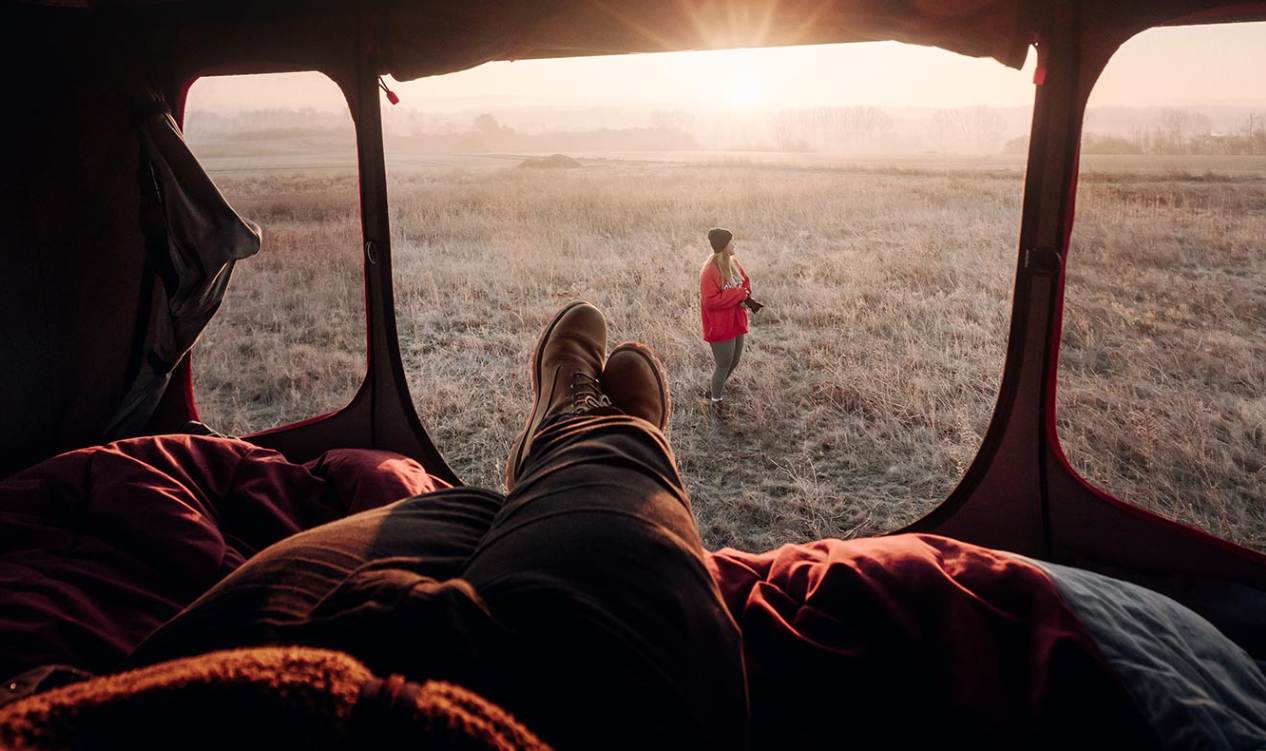
Do you love spontaneously hopping in the car and driving off – out of everyday life, into adventure? Then a car roof tent is just the thing for you. It transforms your vehicle into a safe, comfortable sleeping place in seconds – weatherproof, mobile, and completely independent.
In this article, we’ll show you why hardshell roof tents are the ultimate for camping fans, how they differ from other variants such as the hybrid roof tent, what you should look for when buying, and which models are particularly recommended. You’ll also learn how to optimally use your roof tent, expand it sensibly, and what really matters when it comes to equipment and accessories.
Camping Guide
At a Glance: the most Important Points about the Hardshell Roof Tent
A hardshell roof tent is the ideal choice for those who seek adventure and don’t want to sacrifice comfort. It transforms your vehicle into a weatherproof and quick home without much effort. The tents are usually made of aluminum or fiber-reinforced plastic, offer space for 1 to 4 people, and are perfect for spontaneous trips as well as longer journeys.
Advantages of a hardshell roof tent:
- Quick setup (in 15–60 seconds) – perfect for spontaneous trips
- Weatherproof and robust – protects against wind, rain, and cold
- Comfort – integrated cold foam mattresses and breathable underlays for restful sleep
- Space-saving – can be easily stowed on the roof and quickly removed when not in use
- Durable – the stable hardshell protects the tent from external influences and is easy to clean
What is a Hardshell Roof Tent?
A hardshell roof tent is a tent that is housed in a stable outer shell and is permanently mounted on the car roof. The hardshell is usually made of aluminum or fiber-reinforced plastic, is aerodynamically shaped, and protects the tent from wind, weather, and UV radiation when closed. When the shell is opened, the tent unfolds by itself and offers you a protected sleeping place in seconds. Depending on the model, it can accommodate up to four people – ideal for couples, small groups, or family vacations.
A hardshell roof tent works like any other roof tent – but thanks to its design, it is significantly more resistant, comfortable, and durable. It is suitable for almost all common vehicles – from small cars to off-roaders – and transforms any car roof into a fully-fledged overnight accommodation. However, the prerequisite is that your car has the necessary mounting points for the roof racks. Because without roof racks, the installation of the roof tent is not possible!
That’s what makes a hardshell roof tent:
- Made of hard plastic or aluminum
- Particularly robust, weatherproof, and durable
- Easy and quick setup
- Stable hardshell roof with protection in wind and weather
- Space for up to 4 people – ideal for families and groups
👉🏻 Discover hardshell roof tents for 2 people here
Advantages of a Hardshell Roof Tent when Camping
A hardshell roof tent brings many practical features that set it apart from other types of tents. It is quick to setup, weatherproof, comfortable, and makes your car the ideal companion – whether for short trips or longer journeys. The following points will show you what really distinguishes a hardshell roof tent in everyday life – and why it has become the first choice for so many people.
1. Quick Setup and Dismantling
A hardshell roof tent is ready for use in a few seconds – without poles, pegs, or complicated rods. The hard shell opens almost by itself using gas pressure springs or a crank. The tent folds out automatically, so you immediately have a protected sleeping place.
Dismantling is also uncomplicated: simply close the shell again – done. This not only saves time, but also makes camping much more relaxed, even in bad weather or at dusk.
2. Weather Resistance and Stability
The aluminum hardshell not only protects against the elements during the journey, but also ensures stability when set up. The high-quality tent fabric and the sturdy zippers make the tent a reliable retreat in rain, wind, and cold. The hard shell also withstands falling branches, pine cones, or even smaller bumps without any problems. Models with an aluminum shell offer even more protection and are ideal for demanding regions and longer journeys.
3. Comfort and Sleep Quality
A hardshell roof tent offers you a surprisingly high level of comfort when camping. Most models already have a comfortable cold foam mattress installed. In combination with a breathable 3D mesh underlay, a pleasant lying surface is created – almost like in your bed at home.
Since you sleep in an elevated position, you are not lying directly on the ground. This means: no ground cold, no moisture from below, and no creepy crawlies in the sleeping area. Even on uneven terrain, you sleep peacefully and safely – your roof tent always remains level and dry.
4. Camping without a Camper
A hardshell roof tent turns your car into a small home – without any conversion or your own motorhome. You don’t need a camper or van, but simply use your existing vehicle. This not only saves money, but also space, for example when storing it in winter.
You can stay overnight wherever it is allowed – in the mountain car park, by the lake, or in the middle of nature. You are independent of campsites and fixed pitches. This is a huge advantage, especially for road trips or spontaneous excursions. And although you don’t have to sacrifice comfort, you travel cheaper and with less effort than with a motorhome or tent.
5. Space-saving Storage
A hardshell roof tent is not only practical during the journey, but also when it is not needed. Thanks to the flat, aerodynamic design, it remains inconspicuous on the vehicle roof – ideal for those who want to use their car in everyday life.
Outside the camping season, the tent can be easily removed and stowed away. Whether lying in the garage or upright on a wall bracket – the required storage space is manageable. You don’t need a parking space like for a motorhome or elaborate accommodation.
6. Longevity
A hardshell roof tent can withstand a lot – and for many years. The hard outer shell protects the tent from rain, sun, dirt, and minor impacts. Compared to other types of tents, it is much more robust and wears out more slowly.
In addition, the hardshell is easy to clean. Usually a damp cloth or some water is enough to remove dust and dirt. If you regularly care for the tent and store it dry, you hardly have to worry about damage or wear and tear – ideal for those who want to use their roof tent often and for a long time.
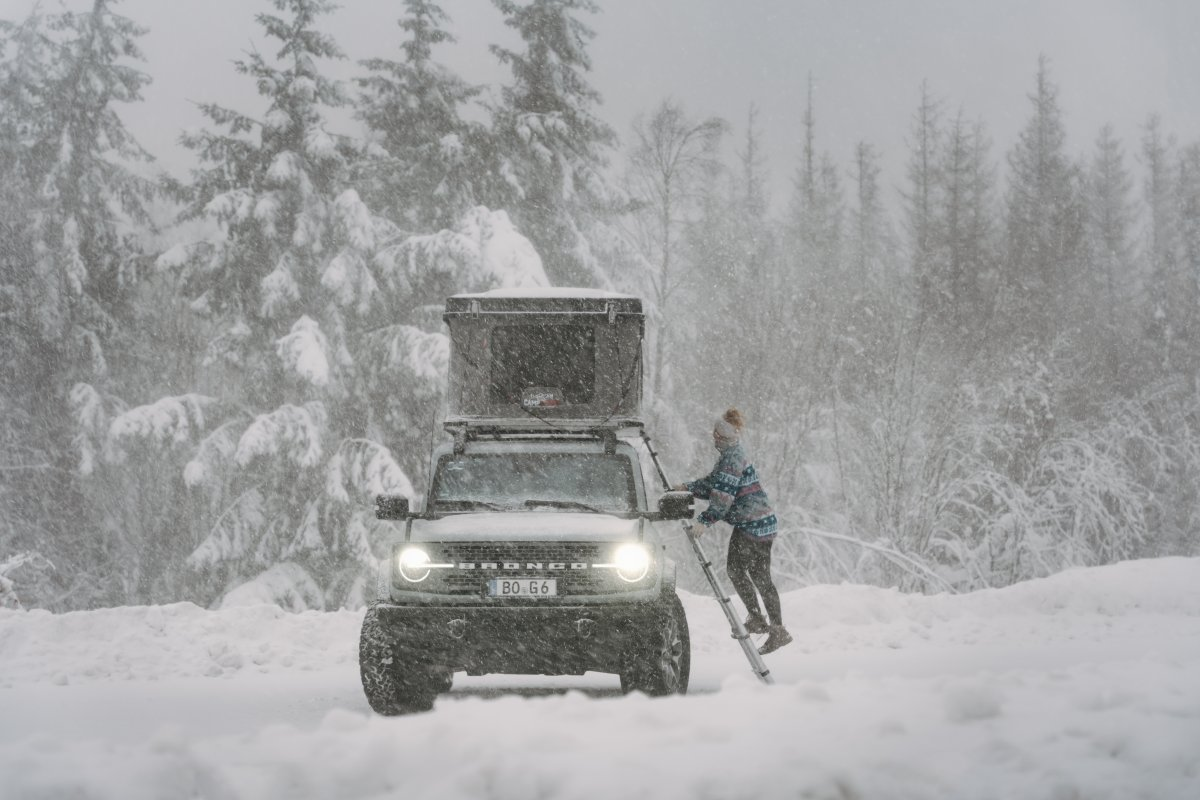
Hardshell vs. Softshell vs. Hybrid – a Comparison
Not every roof tent works the same – depending on the design, setup, comfort, weight, and weather protection differ significantly. To help you better assess which model suits your needs, we have done a roof tent test of the three common variants. The overview shows you what matters – and why hardshell roof tents are particularly practical in many areas.
| Feature | Hardshell roof tent | Softshell | Hybrid Roof Tents |
| Assembly time | very short (15–60 sec.) | long (5–15 min.) | short (1–3 min.) |
| Comfort | high | medium | high |
| Weight | higher (50–75 kg) | light (30–50 kg) | medium (40–75kg) |
| Weather resistance | very high | medium | high |
| Pack size | compact, flat | large, bulky | medium |
| Price | higher (€3000–5500) | cheaper (€2000–4000) | higher (€3000–5500) |
The roof tent comparison shows: Hardshell roof tents score particularly well due to their quick setup and weather resistance. Softshell tents impress with their low weight and a more favorable price. They are well suited if you only use your tent occasionally or in good weather.
Hybrid models combine the quick setup of the hardshell with the generous feeling of space of a softshell tent. They are ideal for those who want a little more space but still value comfort and good weather protection.
However, if you are regularly on the road, want to camp in any weather, and it is important to you that your tent is suitable for everyday use, easy to care for, and quickly ready for use – then a hardshell roof tent is the best choice.
👉🏻 Learn more about the differences between a roof tent with hardshell, softshell, or hybrid
Who is a Hardshell Roof Tent Suitable for?
A hardshell roof tent is suitable for many people who like to be outdoors – whether for a short trip on the weekend or longer journeys across the country. It is particularly practical if you like to be independent and still don’t want to do without a comfortable, weatherproof roof over your head.
These groups particularly benefit from a hardshell roof tent:
- Couples who are looking for a compact and cozy sleeping system that works without much effort
- Families who want to offer their children a safe and dry sleeping environment – even in wind and rain
- Outdoor fans who like to drive off spontaneously, stay overnight in nature, and don’t feel like dealing with tent poles or muddy floors
- Commuters who are regularly on the road and prefer to stay overnight in their own car instead of hotels – without sacrificing comfort
- Digital nomads who work, live, and travel on the road – and use a roof tent as a fixed part of their mobile everyday life: with solar panels, internet, and everything else that goes with it
Which Car Does a Hardshell Roof Tent Fit on?
A roof tent can basically be mounted on almost any vehicle, as long as it has the right roof racks and sufficient roof load. The roof load is composed of the dynamic (while driving) and the static (when stationary) roof load. You can find the exact values in the operating manual of your vehicle. Make sure that you do not exceed the permissible values in order to mount the tent safely.
For smaller vehicles such as city cars or small cars, lighter models with a narrow roof shell are recommended. These offer enough space for 1–2 people and are particularly easy to handle during setup and dismantling.
For larger vehicles such as SUVs, vans, or off-roaders, you can choose wider tents that offer more lying surface and storage space. These are well suited for longer journeys or larger groups.
When buying, make sure that the roof racks have the right load-bearing capacity to safely carry the weight of the tent.
👉🏻 How to find the right roof racks for your roof tent.
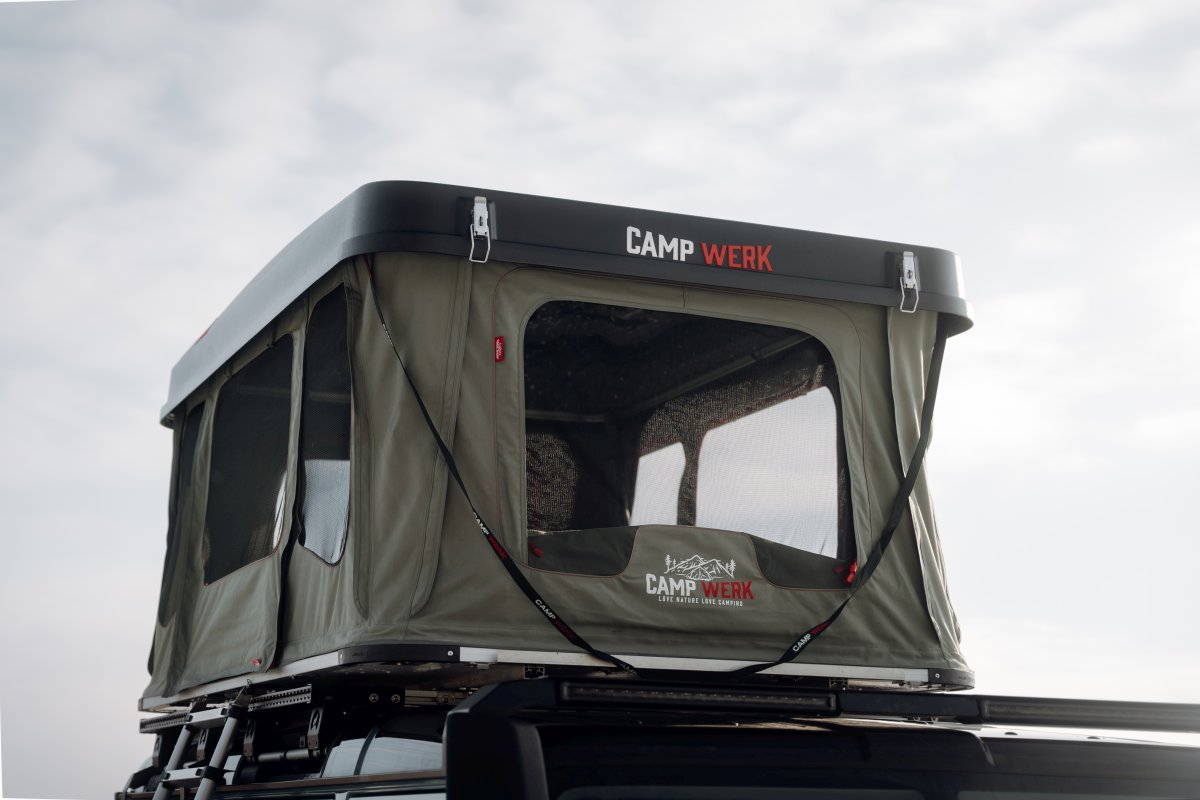
What You should Pay Attention to when Buying – Models, Quality, New or Used?
When buying a hardshell roof tent, there are several factors that you should consider so that you can enjoy it for a long time. Here are the most important points:
- Size:
Consider how many people will regularly sleep in the roof tent. There are models for 1–2 people and larger roof tents that offer space for up to 3 or 4 people. Make sure that there is enough space for all your equipment and that you can sleep comfortably. - Weight:
The tent should match the roof load of your car. Find out about the permissible roof load in the operating manual of your vehicle and make sure that the combination of roof tent and accessories does not exceed this. Too heavy roof tents can negatively affect the handling and also strain the carriers. - Setup:
Pay attention to the mechanism with which the roof tent is set up. Models with gas pressure springs can be opened and closed particularly quickly. If you have to set up and dismantle the roof tent often, a simple and quick roof tent system is particularly advantageous. Folding systems often offer more space, but require more time to set up. - Condition:
If you are considering a used roof tent, you should pay close attention to the condition of the shell, tent fabric, zippers, and mattress. Used roof tents may have signs of wear or minor damage that are not immediately apparent, which can lead to leaks or loss of stability in the long term. A new roof tent always offers you the security that it is in perfect condition and that you will not discover any unexpected defects.
At CAMPWERK you get high-quality, new hardshell roof tents that are particularly durable and weatherproof.
In contrast to used roof tents, which can often have hidden defects, you can be sure at CAMPWERK that your roof tent is in perfect condition and that you will not experience any unexpected surprises.
Thanks to easy setup, the roof tents can be quickly attached to your vehicle. This saves you time and allows you to fully concentrate on your adventure. With competent consulting and transparent prices, you not only get a roof tent, but also the support you need to make the best choice.
👉🏻 Discover all our hardshell roof tents on our website
Recommended Models: BDV and Good Vibes
Blue Dot Voyager (BDV): the Perfect Roof Tent for Adventurers
The BDV from iKamper is a wedge roof tent that was specially developed for adventurous campers who are not afraid of extreme weather conditions. Whether you’re paddling through the wilderness with a kayak or have your axe with you – this roof tent is the ideal companion for your outdoor trips.
The stable wedge shape of the BDV ensures that you have a safe sleeping place even in windy and stormy conditions. With numerous expansion options, such as a railing that allows you to safely transport your outdoor equipment or sports equipment, the BDV is the perfect companion for any adventure. Despite the robust design, the roof tent remains very compact when closed with a height of only about 20 cm.
BDV Duo
- 1–2 people
- Setup time: approx. 15 seconds
- Lying surface: 135 x 213 cm
- Pack size: 149 x 228 cm
- Weight: approx. 67 kg + 6 kg for the ladder
- Material: Eco-materials for the tent fabric
The BDV Duo is the perfect choice for adventurers seeking freedom on their travels without sacrificing comfort. With its sturdy construction and a wide sleeping area, it offers enough space for you and your travel companion.
BDV Solo
- 1 person
- Setup time: approx. 15 seconds
- Sleeping area: 96 x 213 cm
- Packed dimensions: 107 x 229 cm
- Weight: approx. 50 kg + 6 kg for the ladder
- Material: Eco-materials for the tent fabric
For solo travelers and outdoor enthusiasts who appreciate minimalist camping, the BDV Solo is the ideal choice. With a sleeping area of 96 x 213 cm, it offers enough space for one person and is one of the lightest roof tents on the market. It fits on the car roof and still leaves room for additional camping accessories, such as your kayak. Despite its compact design, it offers all the advantages of the BDV Duo model.
👉🏻 more about the BDV Duo and Solo
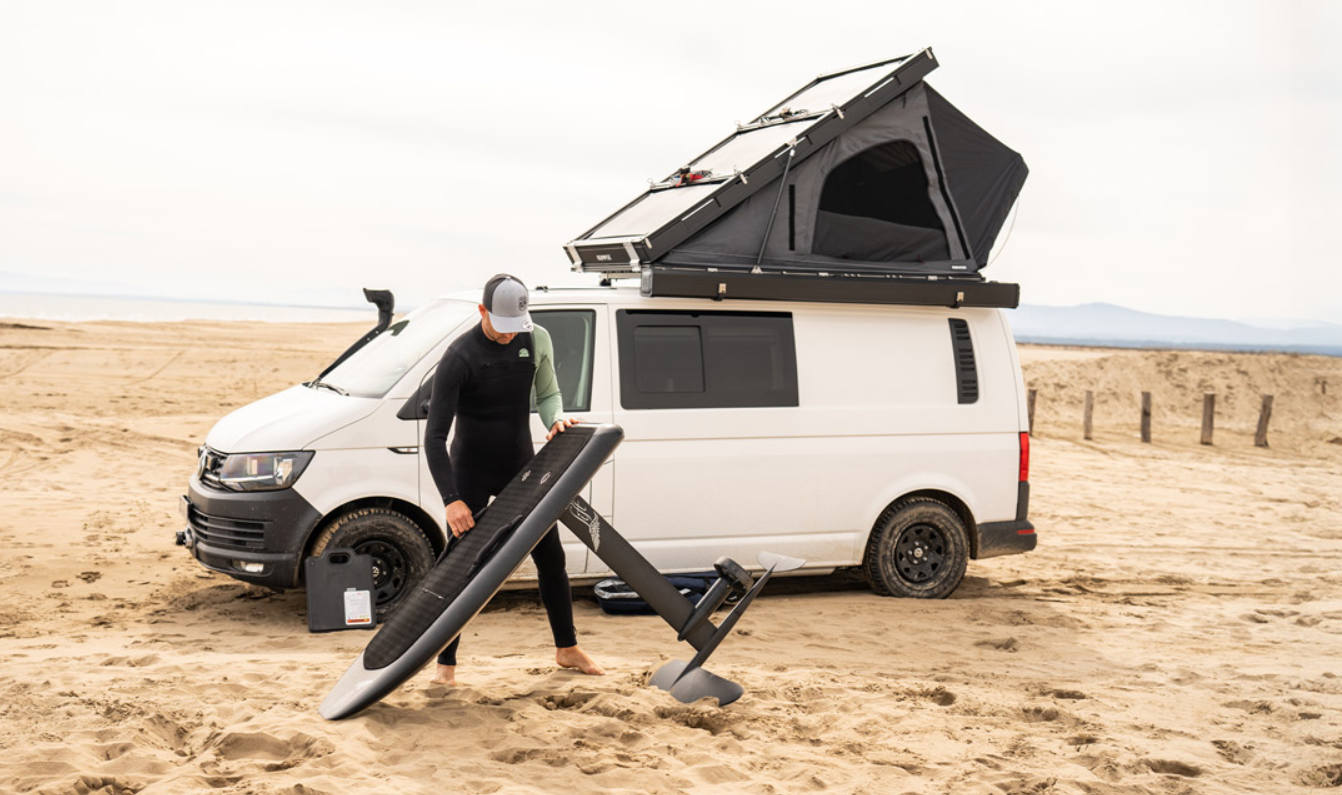
Good Vibes: Hard Shell Roof Tent for Maximum Comfort
The Good Vibes was CAMPWERK’s first hard shell roof tent and sets new standards for your camping experience. With a quick setup, a generous headroom and the impressive view of the surroundings, it offers everything you need for unforgettable adventures in nature.
The hard shell provides additional protection in all weather conditions, while you enjoy maximum comfort in the compact tent. Thanks to the clever rain shield extensions, your roof tent always stays dry, even when the weather isn’t cooperating.
The Good Vibes not only offers you a comfortable sleeping area, but also a great sense of space – perfect for 2 people and a child or for couples looking for an adventurous experience on the road.
Good Vibes Roof top tent
- 1-2, 5 people
- Sleeping area: 133 x 200 cm
- Setup time: approx. 15 seconds
- Packed dimensions: 144 x 210 cm
- Weight: approx. 68 kg + 6 kg for the ladder
- Material: Fiberglass hard shell, cotton blend tent fabric
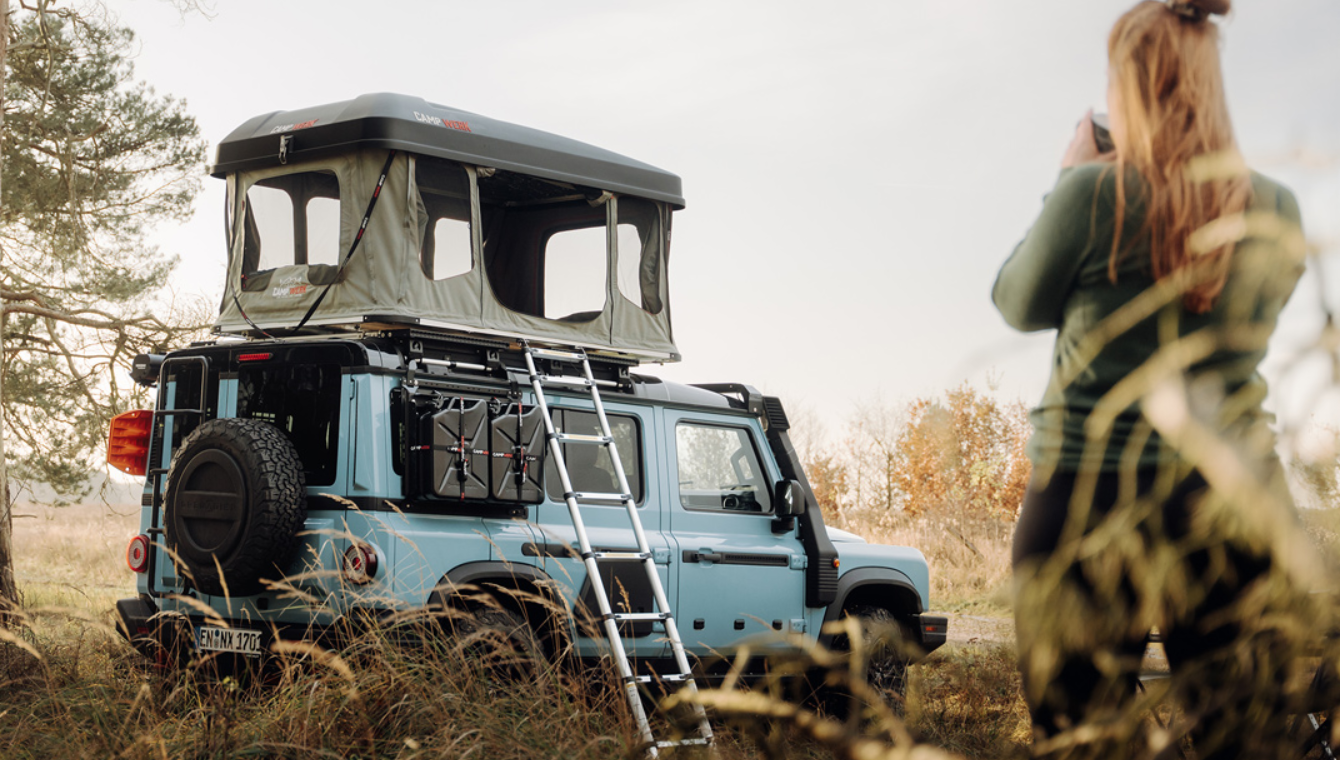
Tips for your First Trip with a Hard Shell Roof Tent
The first trip with your new hard shell roof tent is an exciting adventure – and a great opportunity to really get to know the roof tent. To help you get off to a relaxed start and ensure your vacation runs smoothly, here are 5 practical tips to help you on your first trip:
- Tip 1: Test the roof tent in advance
Set up and take down your roof tent completely at home. This will give you a feel for the mechanics and you will be much faster on the first use on the road. You will spend less time with the setup and can act stress-free in unexpected situations, such as bad weather or darkness. - Tip 2: Create a packing list
Plan early what you want to take with you. Things like headlamps, tools, tension ropes, gas cookers, water canisters, camping chairs and bedding belong in every roof tent adventure. Think about what you really need, and pack a little too much rather than too little. Also think about rain protection or extra blankets in case the weather changes. - Tip 3: Check roof load and mounting
Safety should always come first. Before departure, be sure to check the stability of the roof racks and make sure that the roof tent is mounted correctly. Also make sure that the weight of the roof tent and accessories does not exceed the permissible roof load of your vehicle to avoid problems while driving. It is best to have the installation carried out by an expert like CAMPWERK to ensure that everything is properly and safely attached. - Tip 4: Route planning and travel organization
Plan the route and always keep a little room for spontaneous discoveries. Use apps or maps to find possible pitches, but also be prepared to simply stop where you like. The roof tent is your mobile home – use the freedom to linger anywhere on the road. - Tip 5: Weatherproof equipment
Even if the weather forecast looks good, unexpected rain showers or cool nights may await you. So pack waterproof clothing, extra layers for cold evenings and an over-tent for extra weather protection. Also think about sturdy boxes or bags to store your equipment safely and dry.
With these preparations, your first trip with the hard shell roof tent will be a relaxed and unforgettable experience – without hotel commitments or unnecessary stress. So you can enjoy camping to the fullest.
Conclusion: is a Hard Shell Roof Tent Worth it?
Yes, a roof tent with a hard shell is worth it!
A hard shell roof tent is more than just an overnight stay on the car roof – it is the perfect companion for those who seek adventure without sacrificing comfort. You are protected from wind and weather, it can be easily unfolded and is easy to clean in case of dirt.
Whether for families, couples or solo travelers – hard shell roof tents are available in many different designs and sizes, so there is a suitable model for everyone.
Of course, it is initially a little more expensive, but you get a roof tent that will provide loyal service for years and on numerous excursions.
So if you are planning longer and more demanding camping tours and regularly stay overnight at natural campsites, then a hard shell roof tent is the right choice!
At CAMPWERK you will find high-quality, new roof tents that are not only easy to assemble, but also impress with their robust construction. With the ” Skycamp 2.0 you get a spacious model that is ideal for families or small groups. If you like it a little more compact, the ” Skycamp Mini is the perfect choice for couples or solo adventurers who still don’t want to sacrifice comfort.
👉🏻 Buy your new hard shell roof tent here!
FAQ – Frequently Asked Questions about Hard Shell Roof Tents
1. How many people fit in a hard shell roof tent?
Depending on the model, the capacity varies between 1 and 4 people. For families or small groups, there are also roof tents with an extended sleeping area or additional awning areas that offer more space. When buying, pay attention to the size of the roof tent so that you have enough space for yourself and your fellow travelers.
2. How heavy is a hard shell roof tent?
Most models weigh between 50 and 75 kg, with the weight varying depending on the size, material (e.g. aluminum hard shell) and equipment. Larger roof tents for families or with additional storage space may be slightly heavier. The weight has an impact on the roof load of your vehicle, so it is important to check the permissible roof load.
3. Is a hard shell roof tent suitable for winter?
Yes, many hard shell roof tents are suitable for winter use, especially models equipped with thermal inlays and insulating mattresses. These keep the cold out and ensure a comfortable sleeping comfort, even at temperatures below 0 °C. It is important that you adjust the tent ventilation correctly to avoid condensation.
4. Can I assemble the roof tent alone?
It is generally possible to assemble a hard shell roof tent alone, but it will be easier and safer if you have two people to help. Some models can be opened quickly with gas pressure springs or crank mechanisms, but the weight and stability of the roof tent should not be underestimated. Professional help is especially recommended if you are unsure or want to assemble a larger roof tent.
5. Are there also used models with warranty?
You can find used hard shell roof tents from private dealers or, for example, on Ebay on the Internet, but these usually do not offer any guarantee or warranty. CAMPWERK sells exclusively new roof tents that come with a warranty. So you can be sure that you will receive a tent in perfect condition. When buying used tents, you should carefully check the condition of the roof tent, especially the shell, zippers and mattress, as these factors can affect the life of the tent.
6. How long does it take to set up a hard shell roof tent?
A hard shell roof tent is known for its quick setup. Most models can be unfolded in 15–60 seconds – thanks to gas pressure springs or a crank mechanism. This saves you valuable time and allows you to relax faster, even in bad weather conditions or late in the evening.
7. How do I clean my hard shell roof tent properly?
Normally, the dirt rolls off on contact with water. If that’s not enough, we recommend our tent cleaner. For the outer shell, a damp cloth and some mild detergent are usually sufficient. Make sure that you regularly treat the zippers with a suitable lubricant to extend their service life.
8. How safe is a hard shell roof tent while driving?
A hard shell roof tent is designed to stay safely on your vehicle while driving. Make sure that you check the roof racks regularly and ensure that the roof tent is properly attached. Many models are aerodynamically designed, which minimizes air resistance and keeps fuel consumption low. However, improper installation or excessive weight can lead to instability, so you should always follow the manufacturer’s recommendations.
9. Can I fold up my tent even if it is wet from the rain?
Yes, that’s no problem. Make sure that all doors and windows are closed and fold the roof tent together. It is okay to pack the tent damp for a few days. However, you should set it up in a dry place for ventilation after three days at the latest.
10. Where can I stand with my roof tent?
If you simply park the car, the roof tent is not a problem as long as it is in a place where normal cars are allowed to park. As a rule, you can stand and sleep in the roof tent throughout Europe for up to 24 hours, as long as there is no explicit ban on overnight stays indicated by signs. However, as soon as you are camping, i.e. sitting in front of the car with a table and chairs, this is not permitted in public parking lots. In addition, it could be problematic if your roof tent protrudes beyond the vehicle boundary.