


You’re driving through a picturesque landscape and think to yourself: “It’s worth staying here longer.” And in less than 10 minutes, you’ve already set up your bedroom on the roof – comfortable, stable and weatherproof. If you are an enthusiastic camper or adventure traveler, then a roof tent might be the ideal companion for you.
In this article, you will learn what an inflatable roof tent is and what advantages and disadvantages it has. We will also show you what you need to consider when it comes to the roof load and why an alternative to the inflatable roof tent is worthwhile. With our practical checklist, you can see at a glance which points you should consider when buying your mobile tent.
Camping Guide
The most Important Facts about Inflatable Roof Tents at a Glance:
Inflatable roof tents offer a quick and easy setup, but are more sensitive and less stable than hard-shell and folding roof tents. They are only suitable for minimalist camping trips and offer less comfort.
Roof tents are lightweight, space-saving to store and can be mounted on almost any type of vehicle. You just have to pay attention to the roof load.
For the setup, you only need to position, fasten and inflate your roof tent. You can do the assembly yourself or have it done professionally.
What is an Inflatable Roof Tent?
An inflatable roof tent is a tent that you can mount on the roof of your vehicle. It is not held by classic metal or fiberglass poles, but by air-filled supports. These so-called air frames are made of extremely resistant materials that remain stable even under pressure.
The Advantages and Disadvantages of an Inflatable Roof Tent at a Glance
| Advantages of an inflatable roof tent | Disadvantages of an inflatable roof tent |
| ✅ Quick setup in under 10 minutes | ❌ No automatic folding – complicated dismantling, especially on high cars |
| ✅ Low weight thanks to air frame | ❌ Lower stability – especially in wind weaker than aluminum poles |
| ✅ Space-saving design | ❌ More susceptible to damage – e.g. from branches or sharp objects |
| ✅ No poles required | ❌ Loss of pressure in heat, frequent re-inflation required |
Vehicle? Doesn’t Matter, as Long as the Roof Load is Correct
Whether small city car, classic station wagon, spacious SUV or pick-up: You can mount a roof tent on almost any type of vehicle – regardless of whether it is an inflatable roof tent, hard-shell or folding roof tent. The decisive factor is not so much the model of the car as the permissible roof load. This indicates how much weight the vehicle roof including carrier and tent may carry. You can find it in the vehicle registration document or in the operating instructions of your car.
The permissible roof load is a safety-relevant specification of the manufacturer. You should therefore take it seriously. If you exceed the total load, safety risks can arise because your vision and steering behavior are impaired while driving. This is especially noticeable at high speeds. When calculating the roof load, pay attention to:
- Dead weight of the roof tent
- Weight of the roof rack
- possible additional loads (e.g. solar panel, luggage box)
Calculation example: Tent (40 kg) + carrier (10 kg) = 50 kg → with a recommended roof load of 75 kg, there are still 25 kg left for accessories.
Don’t worry: The weight specification of the permissible roof load applies to the condition while driving, not for stationary operation. When camping itself, people may stay in the tent, even if their weight exceeds the driving roof load. This is because the load is evenly distributed when the vehicle is stationary.
💡 Tip: Report to your car insurance company that you have mounted a tent on the roof. This way you are insured in the event of damage.
5 Reasons why You should Choose an Alternative to the Inflatable Roof Tent
Inflatable roof tents are lightweight, compact and quickly ready for use. But they are not the ideal model for every type of camping or every travel situation. There are good reasons why you should opt for an alternative – such as a hard-shell or folding roof tent.
1. Robustness in any weather:
If you are often traveling in wind, rain or in colder regions, hard-shell and folding tents often offer more stability. They are usually made of more resistant materials and can withstand even stronger gusts – without air chambers being able to give way.
2. Maintenance-free:
A classic roof tent works without air pressure. So you don’t have to worry about valves, pumps or pressure checks. Especially on longer tours or changing temperatures, this means: less effort, less risk.
3. Longevity:
Hard-shell tents are considered particularly durable – thanks to a stable outer shell, robust hinges and weatherproof fabrics. Anyone who wants to use their roof tent for many years is well advised to choose this option.
4. More space or extras possible:
Folding roof tents often offer larger lying surfaces and more headroom. Some models can even be extended with awnings or canopies – ideal for families or longer stays in one place.
5. Easier transport:
In contrast to inflatable models, classic roof tents are often flatter and more aerodynamic when folded. This can save fuel and makes driving with a tent on the roof easier.
An inflatable roof tent is more suitable for minimalist campers. But if you are looking for more storage space and stability or want to use your tent all year round, hard-shell or folding tents are the better alternative.
Your Roof Tent Set up in just 5 Steps
Regardless of whether you have an inflatable roof tent or a hard-shell or folding roof tent: Your mobile home makes your travels more flexible and saves time, as you no longer have to look for conventional campsites. You can freely choose your location.
In just 5 steps, your roof tent is set up. This means: Your mobile bedroom is ready for use in less than 10 minutes – even without prior knowledge.
This is how the setup works:
1. Position: Place the roof tent on the pre-assembled roof racks. Make sure that it is centered and symmetrically aligned.
2. Fasten: Use the included tensioning systems, screws and clamps (depending on the model) to securely fix the mobile tent. Tighten everything hand-tight, but not over.
3. Open or unfold: Depending on the tent type, the roof tent is now unfolded, inflated or opened by gas pressure spring. Make sure there is a clean surface and sufficient free space to the side and above.
4. Control: Check the fit of the tent, the stability and, in the case of air tents, also the air pressure. Readjusting or re-inflating can be useful – especially with large temperature differences.
5. Set up the interior: Unroll the mattress, spread out the sleeping bag, hang up the LED light – done!
Setting up your roof tent is very easy. Nevertheless, there are typical mistakes that are made again and again – especially by camping beginners. So that they don’t happen to you, we’ll show you what you should avoid:
❌ Incorrect fastening of the tent: If the tent is not correctly mounted on the roof rack, it can come loose while driving.
❌ Tent type-specific errors:
- Folding tent: Not all tensioning straps released
- Hard-shell tent: Gas pressure springs not fully engaged
- Inflatable roof tent: Not sufficiently inflated or air pressure not adjusted
❌ Uneven setup: A tilted position or twisted alignment can be disturbing when sleeping and put a strain on the material.
Take enough time for the first setup and read the instructions carefully. Then nothing stands in the way of your adventure in the roof tent.
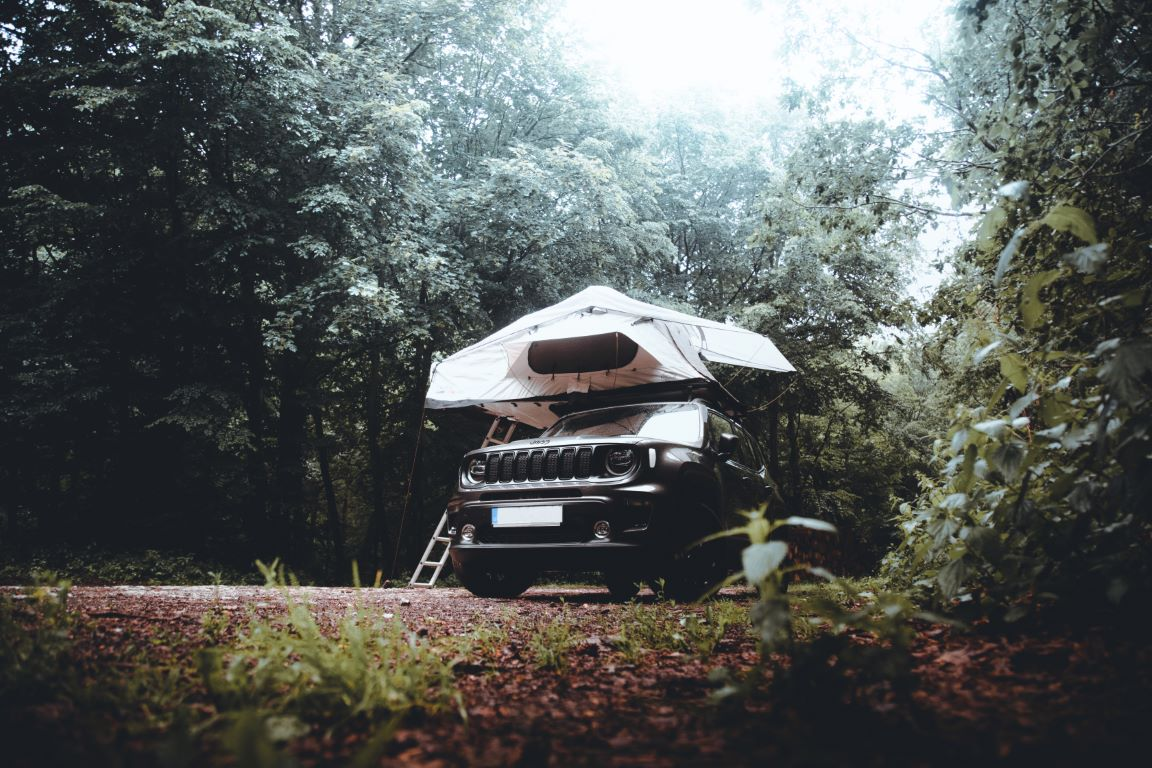
Optional Accessories for an Even more Comfortable Camping Experience
There are a variety of extensions for your tent on the car roof that significantly increase functionality and comfort. The following extras are particularly worthwhile:
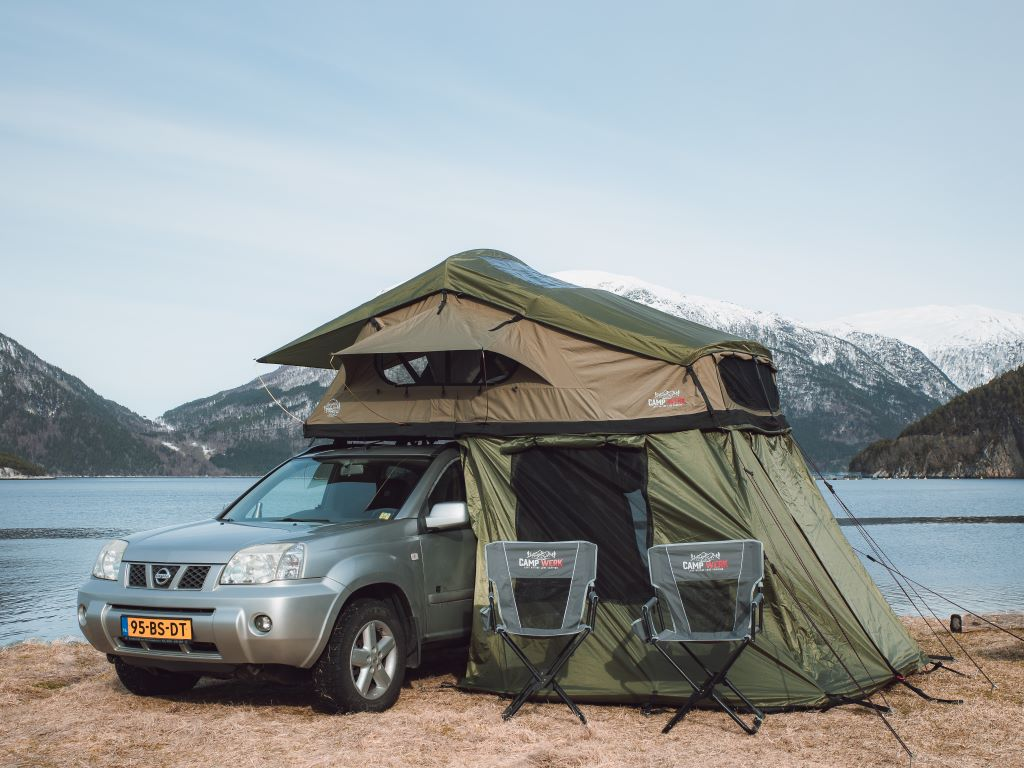
- Inflatable awning: Creates additional protected space for cooking, storing or relaxing – a must, especially in bad weather.
- Awning: Offers protection from sun and rain, provides shade and transforms your campsite into a cozy outdoor oasis.
- Solar panel: Ideal for maximum independence on the road – provides you with electricity for light, cooler or smartphone.
- LED lighting systems: Provide pleasant lighting and more safety at the campsite.
- Theft protection: Protect your equipment – both tent and carrier.
With your accessories, you can design your roof tent according to your wishes – and enjoy your camping adventure to the fullest.
Checklist: What You should Consider when Buying a Roof Tent
✅ Weight and packed size:
Pay attention to the total weight of the tent and the size when packed.
✅ Roof load of your vehicle:
Before you buy a roof tent, check the permissible roof load of your vehicle.
✅ Material and weather resistance:
Since your tent will be used in various weather conditions, the choice of material is crucial. Make sure that the tent is made of robust, weatherproof materials that can withstand both rain and wind. High-quality, UV-resistant fabrics are particularly important to make the tent durable and resistant. This protects you in any weather.
✅ Comfort and interior:
Comfort should not be neglected in a roof tent. Check whether the tent is equipped with a comfortable mattress, robust floor tubs and enough space for you and your fellow travelers. Some models offer additional comfort features such as integrated LED lights or good ventilation to improve the sleeping climate.
✅ Setup and handling:
Pay attention to how easy the tent is to set up. A good roof tent should be quick and intuitive to assemble – ideally in less than 10 minutes.
✅ Accessories and expansion options:
Many inflatable roof tents or hard-shell and folding roof tents offer practical accessories that make the camping experience even more comfortable. These include inflatable awnings, canopies or solar panels. Consider whether you need additional equipment to improve your stay in the tent and make it more weather-independent.
Self-assembly or Professional Setup? This is how You Make the Right Decision
The assembly of a roof tent is uncomplicated. Nevertheless, the question arises: Do it yourself or have it done by a professional? Both variants have their advantages and disadvantages. This depends on your experience, your time budget and safety requirements.
Self-assembly – for everyone with craftsmanship:
- Advantage: You save the assembly costs.
- You get to know your mobile tent better. If you know all the functions exactly, the setup and dismantling is particularly easy.
- But: Without experience, errors can occur during fastening.
Professional assembly – for everyone who wants to play it safe:
- Advantage: The entire process is accompanied by experts – from the selection of the carrier to the last valve.
- You will receive a personal briefing and valuable tips for everyday life.
- Sources of error are excluded.
Conclusion: For experienced users, self-assembly is a good option. However, anyone looking for maximum safety and comfort is well advised to opt for professional assembly.
Are you looking for a provider for roof tents? Then come to one of our 6 branches and find the ideal roof tent for your car at Campwerk! On request, we can also mount your tent directly on your car roof.
Why Campwerk is the Right Choice for your Alternative to the Inflatable Roof Tent
⛺ Over 10 years of experience: We have been a leader in the field of roof tents and camping equipment since 2010. This gives us the necessary know-how to help you choose your ideal roof tent.
⛺ Extensive range: Whether you want a hard-shell tent, extra-large windows or a sleeping space for 4 people – we are guaranteed to have the right tent for you.
⛺ Professional assembly service with instruction: Our experts attach your mobile tent directly to your car on site and instruct you in the functions and handling.
⛺ Accessories offer: Whether awnings, annexrooms, lighting systems, solar panels or an extension for your ladder – we have an extensive range of accessories for you in our range.
Find your roof tent and exciting camping products for your next road trip at Campwerk.
Conclusion: why an Alternative to the Inflatable Roof Tent is the Better Choice
A roof tent offers numerous advantages and is the ideal choice for spontaneous and comfortable camping. With a quick and easy setup in just 5 steps, you have a mobile home on your vehicle roof in less than 10 minutes. Perfect for road trips and weekend trips of all kinds. However, an inflatable roof tent is only suitable for minimalist campers. Hard-shell and folding roof tents are in any case the more comfortable alternative.
Your roof tent can be mounted on almost any type of vehicle. The most important requirement is to observe the permissible roof load. Furthermore, your roof tent offers easy handling: You can even set it up yourself, but you can also have it installed by a professional. Optional accessories such as awnings, canopies or solar panels extend your camping experience and make it even more comfortable. If you like camping, you will love your roof tent.
Find your roof tent at Campwerk now and start your next adventure with maximum sleeping comfort.
Frequently Asked Questions about Alternatives to Inflatable Roof Tents
Who is an inflatable roof tent not suitable for?
Inflatable roof tents are less ideal for campers who regularly travel in strong winds, cold weather or on longer expeditions. Anyone who wants maximum stability, year-round use or more space should consider a hard-shell or folding tent.
What alternatives are there to the inflatable roof tent?
The most common alternatives to the inflatable roof tent are hard-shell and folding roof tents. They are quick to set up, stable, comfortable, weatherproof and ideal for frequent use.
How quickly can I set up a roof tent?
An inflatable tent or hard-shell and folding roof tent can be set up in just 5 easy steps. You just have to position, fasten and unfold, unfold or inflate it. This will take you a maximum of 10 minutes.
Which vehicles are suitable for a roof tent?
Whether you drive a small car or a spacious van: Roof tents can be mounted on almost any vehicle. You only have to take into account the permissible roof load of the vehicle.
How do I find the permissible roof load of my vehicle?
You can find the permissible roof load in the vehicle registration document or in the operating instructions of your car. It indicates how much weight the vehicle roof may carry. However, the permissible roof load only refers to the journey. When parked, there may be significantly more weight on the car roof. So it is not a problem if 2 people or more sleep in the roof tent.
Can I set up the roof tent myself or do I need a professional?
You can set up the roof tent yourself if you have basic manual skills, as the setup is very easy. Alternatively, you can have the setup carried out by a specialist.
What additional accessories are available for a roof tent?
Optional accessories include inflatable awnings, canopies, solar panels, LED lighting systems, and anti-theft devices. They significantly increase comfort and functionality.
How safe is a roof tent while driving?
As long as the tent is correctly attached to the roof rack and the permissible roof load is observed, transporting the tent while driving is safe. Make sure to properly secure the tent and regularly check the air pressure.